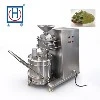
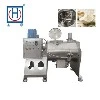
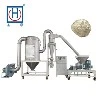
Dry granulation technology does not need to add adhesive or water, pressing particles by physical means, simplifying the production process and retaining the activity of the material. The dry granulator solves the problems of strong adhesion, uneven particle size and poor fluidity, and has the advantages of high efficiency and energy saving, maintaining material activity, environmental protection and energy saving, and automatic production.
In pharmaceutical, food, chemical and other industries, particle preparation is a crucial process. Although the traditional wet granulation is widely used, it has some disadvantages such as high energy consumption, complicated process and easy to affect material activity. With its unique advantages, dry granulation technology has gradually become the best choice in modern industrial production. The dry granulator, as the core equipment of this technology, provides a one-stop solution from raw materials to particles, greatly optimizing the production process, improving product quality and production efficiency.
I. Overview of dry granulation technology
Dry granulation technology is a method of directly pressing the powdery material into the desired particle size by physical means without adding any adhesive or moisture. Compared with the wet process, the dry process eliminates the drying and sintering process, not only simplifies the production process, but also retains the activity of heat-sensitive materials, especially suitable for the granulation production of heat-unstable drugs.

Second, the working principle of dry granulator
The working principle of dry granulator mainly depends on its unique pressing system and structural design. After the material is first mixed evenly, it is fed between the two press rollers through the screw rod. The press roll rotates at a set speed, and the pressure of the press roll is adjusted to make the material form a sheet after being moderately pressed. Subsequently, the formed sheet is cut and pulverized and granulated through a screen to obtain the desired size of dry particles.
Dry granulator is divided into horizontal feeding and vertical feeding two types, the current market is more commonly used horizontal feeding dry granulator. This model can more effectively reduce the undry pressed fine powder missing under the action of gravity, improve the yield of particles, and its rolling zone and particle feeding zone are separated from each other, easy to collect the undry pressed fine powder for dry pressing again, thereby improving production efficiency.
Third, the technical problems solved by dry granulator
In the process of dry granulation, producers often face technical problems such as strong material adhesion, uneven particle size and poor fluidity. The dry granulator solves these problems effectively through a series of innovative designs:
Adhesion problem: The specially designed press wheel and die are used to moderately press the material to reduce the problem of large surface area and strong adhesion caused by the material being too thin. At the same time, the unique pressing principle and structural design ensure smooth and continuous granulation, even at high pressures, to avoid material sticking to the wall.
Uneven particle size problem: The precise control system of the dry granulator can monitor and adjust key parameters such as pressure and speed in real time to ensure that the particles in each batch have good uniformity and repeatability. By optimizing the pressing speed and pressure, the hardness and size of the particles can be effectively controlled to meet the precise requirements of different products.
Poor fluidity problem: In the pelletizing process, the dry granulator can change the shape and size of the particles by adjusting the gap between the press wheel and the mold. The production of larger particles or particularly-shaped particles, such as cylindrical or spherical shapes, can significantly improve the flow of the material and facilitate subsequent packaging and transportation.
Fourth, the advantages of dry granulator
High efficiency and energy saving: the drying and sintering process in the wet process is eliminated, reducing energy consumption and production costs.
Maintain material activity: It is especially suitable for granulation of heat-sensitive materials to maintain its original activity and efficacy.
Environmental protection and energy saving: In the closed granulation system, dust is effectively controlled, reducing material loss, in line with the modern industry's high standard of environmental protection requirements.
Automated production: Through the connection with the computer system, to achieve real-time data recording and tracking, improve production efficiency and quality control level.
To learn more about our Fangyuan products, please click this link :https://www.fine-mill.com/products.
Our WhatsApp:+86 18115325508
E-mail:Johnnson@cnfyjx.com