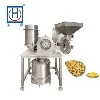
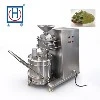
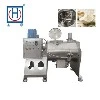
The ultra-fine crusher is made of stainless steel material permitted by medicine, which meets GMP requirements. The production process is fully enclosed, and the ultra-fine crusher has no dust benefits, no material loss, and low crushing temperature - without a cooling system, the powder temperature produced by the ultra-fine crusher will never exceed 50 degrees Celsius under continuous operation. For customers with special requirements, we can configure a low-temperature system, with a minimum temperature of -35 degrees Celsius.
Suitable for any fibrous, high toughness, high hardness or material with a certain moisture content. For materials that require breaking the cell wall of pollen or other spore plants, the wall breaking rate can reach 95%. Water, alcohol or other liquids can be added for wet crushing, or gas can be introduced for protective crushing.
Usually, the particle size of the crusher can be adjusted by changing the feed rate. When the interest rate decreases, finer particles can be produced. Due to the fact that each particle accelerates and impacts the crushing energy, the universal crusher has more energy. Of course, this principle is easy to understand, providing greater power supply can also affect the increase in crushing and obtain more fine grain sizes, which is a prerequisite for energy consumption.
Some products require high-level application of crushing energy for crushing. The crusher can improve the crushing characteristics, increase pressure, temperature, gas flow control, etc. The shape factor also increases and the temperature will change the material. All particle size control also needs to consider the physical and chemical properties of the material.
Adjust the output power diameter of the grinding machine appropriately. Some particles must be processed when they have low resonance, which requires multiple collisions. Therefore, when the resonance is raised for each collision, the given lower energy for particle velocity is smaller. On the other hand, reducing particle realization requires increasing particle velocity.