


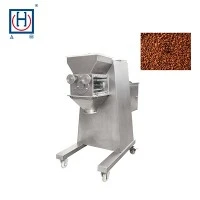


Air Classifying Mill
Introduction
The air classifying mill is a type of grinding machine used in various industries for size reduction and classification of materials. Here's an introduction to its key features and how it works:
Key Components:
Grinding Chamber: This is where the size reduction of the material occurs through mechanical forces such as impact, attrition, and shear. The design of the grinding chamber can vary depending on the specific application and desired particle size distribution.
Classifier Section: The classifier is an integral part of the air classifying mill and is responsible for separating particles based on their size and aerodynamic properties. It ensures that the desired particle size is achieved in the final product by directing coarse particles back to the grinding zone for further reduction and allowing fine particles to exit the mill as the product.
Airflow System: An airflow system, typically generated by a fan or blower, is used to transport the ground particles from the grinding chamber to the classifier section. Controlling the airflow rate and direction allows for precise control over the classification process and the fineness of the final product.
Product Collection System: Once classified, the product is collected either directly from the classifier or through a separate collection system. The design of the collection system may vary depending on factors such as the nature of the material being processed and the desired product handling requirements.
Features:
Air Classification System: The distinguishing feature of an air classifying mill is its integrated air classification system. This system allows for precise control over the particle size distribution of the final product.
Particle Size Control: Air classifying mills are capable of producing a wide range of particle sizes, from a few microns to several millimeters, depending on the specific model and application requirements.
Versatility: These mills can handle a variety of materials, including powders, granules, and even some fibrous materials. They are used in industries such as pharmaceuticals, chemicals, food processing, minerals, and many others.
Grinding and Classifying in One Unit: Unlike traditional grinding mills, air classifying mills combine grinding and classification into a single unit operation. This integration enhances efficiency and reduces the need for separate equipment.
Airflow Control: The airflow within the mill can be adjusted to control the residence time of particles in the grinding chamber, thus allowing for precise control over the fineness of the final product.

Working principle:

Material Feeding: The material to be processed is fed into the grinding chamber either manually or via a feeding mechanism such as a screw feeder or gravity feed.
Grinding: Inside the grinding chamber, the material is subjected to mechanical forces such as impact, attrition, and shear, resulting in size reduction. The grinding elements can vary depending on the specific application but typically include hammers, pins, or discs.
Air Classification: As the ground particles are entrained in the airflow generated by the mill's fan or blower, they are carried upward to the classifier section. In the classifier, particles of different sizes are separated based on their aerodynamic properties. Coarse particles are centrifugally separated and returned to the grinding zone for further size reduction, while fine particles are carried out of the mill as the product.
Product Collection: The classified product is collected either directly from the classifier or via a separate collection system, depending on the design of the mill.
Technical parameters
| Model | Main Structural Dimensions(mm) | Capacity |
Input Particle Size |
Output Particle Size |
Speed | Machine Weight | Total Power | ||||||
| L1 | L2 | H1 | H2 | H3 | H4 | W1 | Kg/h | mm | mesh | rpm | Kg | Kw | |
| WF-30 | 4650 | 5200 | 2540 | 1080 | 650 | 350 | 1380 | 100-400 | <10 | 12-120 | 3800 | 850 | 12.25 |
| WF-40 | 5200 | 5500 | 2800 | 1150 | 650 | 350 | 1450 | 200-800 | <12 | 12-120 | 3400 | 1200 | 19.25 |
| WF-50 | 5450 | 7050 | 2800 | 1400 | 650 | 350 | 1550 | 280-1000 | <15 | 12-120 | 2900 | 1350 | 30.6 |
| WF-60 | 5800 | 7400 | 3150 | 1460 | 650 | 350 | 1550 | 300-1200 | <15 | 12-120 | 2300 | 1500 | 38.1 |
| WF-80 | 6100 | 7900 | 3250 | 1570 | 650 | 400 | 1600 | 400-1800 | <20 | 12-120 | 1800 | 2100 | 68.5 |
| WF-100 | 6750 | 8550 | 3350 | 1800 | 650 | 400 | 1750 | 500-2000 | <20 | 12-120 | 1400 | 2400 | 86.5 |
FAQ
1. Q: How does an air classifying mill work?
A: The material to be processed is fed into the grinding chamber where it undergoes size reduction through mechanical forces such as impact, attrition, and shear. Simultaneously, an airflow generated by the mill's fan or blower carries the ground particles to the classifier section, where they are separated based on their aerodynamic properties. Coarse particles are returned for further grinding, while fine particles are collected as the product.
2. Q: What types of materials can be processed using an air classifying mill?
A: Air classifying mills can handle a wide range of materials, including powders, granules, and some fibrous materials. Common applications include grinding and classifying materials such as chemicals, pharmaceuticals, minerals, pigments, food ingredients, and plastics.
3. Q: What are the advantages of using an air classifying mill?
A: Some advantages of air classifying mills include:
Precise control over particle size distribution.
Versatility in handling various materials and producing different particle sizes.
Integration of grinding and classification into a single unit operation, enhancing efficiency.
Adjustable airflow for controlling product fineness.
Ability to process both dry and moist materials.
Hot Tags: air classifying mill, China air classifying mill manufacturers, suppliers, factory, Mustard Powder Ultrafine Mill, Tomato Powder Making Machine, Dust Free Crusher, Matcha Milling Machine, Micronizer Mill, Cowhide Granule Freezing Pulverizer
Previous
Yam Flour Making MachineYou Might Also Like


Send Inquiry