



Screw Conveyor




Introduction
Screw Conveyor is commonly employed in powder feeding processes in granulation, plastic, plastic, food, and chemical manufacturing.When used in conjunction with injection molding machines, mixing machines, quantitative packaging machines, quantitative packaging scales, and so on, it is ideal for lifting materials to a specific height.
Working Principle
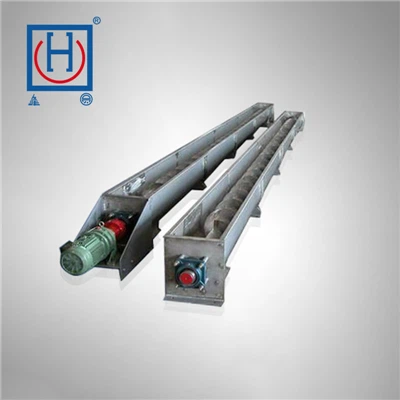
Screw Conveyor adopts no central shaft design, structure, mainly by the motor, reducer, mechanical seal, flexible shaftless helix, U-shaped groove and protective bushing, other supporting accessories and legs, cover, end cover and flange. Screw conveyor is driven by the motor cycloidal reducer operation, by mechanical seal shaft and shaftless spiral body on the connection disk drive and make the spiral rotation work, when the sludge discharged to the U-shaped groove upper feed port, that is, through the screw drive sludge discharged by the U-shaped groove lower outlet.
Application
Screw Conveyor is the main unit of mechanized transportation in various departments of industry and agriculture, and has a wide variety of applications. It may minimize labor intensity and enhance work efficiency in transportation. Building materials, chemical, electric power, metallurgy, coal, grain, and other industries, suitable for horizontal or inclined transport of powder, granular, and small block materials such as coal, ash, slag, cement, grain, material temperature less than 200°C. Powder screw conveyors are not ideal for transporting readily metamorphic, viscous, caking-prone materials.
Features
1. Material: 304 stainless steel;
2,With two motors, a feeding motor and a vibrating motor, each with its own switch control;
3, With an opening door at the bottom of the screw for releasing material;
4, Castors are offered for simple movement.
5, High-quality electrical spare components;
Characteristics
Simple structure, small cross-sectional size, good sealing, reliable operation, low manufacturing cost, convenient for intermediate loading and unloading, and it can convey in two opposite directions at the same time. Materials can also be swirled, blended, heated, and cooled during transportation. Through loading and unloading gates, the material flow can be regulated. It is not, however, suited for transporting perishable, sticky, caking, or big chunks of material. Materials are easily fractured during transit, and spirals and troughs are easily worn. The unit power is increased. During use, the trough's sealing must be maintained, and a suitable space should exist between the spiral and the trough.