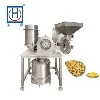
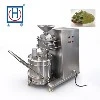
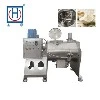
What is dry granulator?
Dry granulator is a machine used in pharmaceutical and chemical industries to convert fine powders into granules. It operates on the principle of compaction, where the powder particles are brought together under high pressure to form a solid mass.
How does dry granulator work?
The dry granulator consists of two rollers that rotate in opposite directions. The powder is fed into the gap between the rollers, where it is pressed and compacted into a solid mass. The compacted mass is then broken down into small granules of uniform size using a milling machine.
What are the advantages of dry granulator?
Dry granulator offers several advantages over wet granulation methods. It eliminates the need for a drying step, which saves time and energy. It also minimizes the risk of contamination since no liquid is involved. Dry granules are more stable and have a longer shelf life than wet granules.

What are the applications of dry granulator?
Dry granulator is widely used in the pharmaceutical and chemical industries for the production of tablets, capsules, and pellets. It is also used in the food industry for the granulation of food ingredients.
What are the types of dry granulator?
Dry granulator can be classified into two types: roll compactor and slugging machine.
Roll compactor
Roll compactor is the most common type of dry granulator. It consists of two counter-rotating rollers that compress the powder into a solid mass. The compacted mass is then broken down into granules of uniform size using a milling machine.
Slugging machine
Slugging machine is a less common type of dry granulator. It consists of a hydraulic press that compresses the powder into large slugs. The slugs are then broken down into granules of uniform size using a milling machine.
What are the factors affecting dry granulation process?
Several factors can affect the dry granulation process, including the type of powder, the particle size distribution, the moisture content, and the compaction force.
Type of powder
The type of powder used in the dry granulation process can affect the quality of the granules produced. Some powders may be difficult to compress, while others may be too cohesive.
Particle size distribution
The particle size distribution of the powder is also an important factor. Powders with a narrow particle size distribution tend to produce more uniform granules.
Moisture content
The moisture content of the powder can affect the flowability and compressibility of the powder. Powders with a high moisture content may require drying before granulation.
Compaction force
The compaction force applied during the granulation process can affect the density, hardness, and friability of the granules produced. High compaction forces can result in dense and hard granules, while low compaction forces can result in friable granules.
What are the challenges of dry granulation process?
Dry granulation process may face several challenges, including poor flowability, poor compressibility, and poor uniformity.
Poor flowability
Some powders may have poor flowability and may not be suitable for the dry granulation process. In such cases, adding glidants or lubricants can improve the flowability of the powder.
Poor compressibility
Some powders may have poor compressibility and may not be suitable for the dry granulation process. In such cases, adding binder materials can improve the compressibility of the powder.
Poor uniformity
Poor uniformity of granules can result in variation in the dosage of the final product. This can be overcome by selecting appropriate powders, optimizing the granulation process, and using appropriate equipment.
Conclusion
Dry granulator is a machine used in the pharmaceutical and chemical industries to convert fine powders into granules. It offers several advantages over wet granulation methods. The dry granulation process may face several challenges, including poor flowability, poor compressibility, and poor uniformity. These challenges can be overcome by selecting appropriate powders, optimizing the granulation process, and using appropriate equipment.