


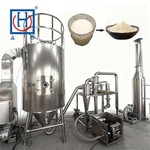


Grain Granulator
Introduction
In the culinary, pharmaceutical, chemical, and other sectors, a type of equipment called a grain granulator is used to crush powdered materials into granules. Grain granulators operate entirely in dry settings and don't require the use of liquid adhesives or moisture, in contrast to conventional wet granulators. Pressing, extrusion, and other processes immediately transform the powdered raw material into particles; this process is frequently used to granulate materials that are moisture-sensitive or unsuitable for usage with moisture.

Working Principle:
Grain granulators work primarily by physically compressing materials into particles; typically, this process involves feeding, crushing, drying, discharging, and other stages. Because no liquid or wet medium is utilized in the dry granulation process, complicated drying procedures are not required of the equipment, resulting in good work efficiency and straightforward operation.

Characteristic:
Technical parameters
| Model | GK-70 | GK-100 | GK-120 | GK-200 |
| Production Capacity(kg/h) | 20-100 | 50-150 | 60-200 | 80-300 |
| Production Size(mm) | 0.5-3 | 0.5-3 | 0.5-3 | 0.5-3 |
| Working Pressure(kn) | 198 | 297 | 294 | 310 |
| Motor Power(kw) | 11.1 | 11.8 | 13.8 | 25 |
| Overall Diemensions(L*W*H)(mm) | 1600*1000*2230 | 1560*1000*2230 | 1560*1000*2230 | 2150*1250*2700 |
| Weight(kg) | 2000 | 2200 | 2500 | 3500 |
FAQ
1. Q: What are the main application areas of grain granulator?
A: Grain granulator is widely used in many industries, mainly including: for food raw materials such as starch, sugar, spices, granule preparation and drying. In the pharmaceutical process, it is often used for the drying and molding of drug particles, especially for some drugs that are not suitable for wet granulation. It is also used in the production of granular materials in agriculture and chemical industry.
2. Q: What is the difference between dry grain and wet grain?
A: Dry granulation: do not use liquid binder, but by pressing, extrusion and other ways to granulate the powder. There is no wetting step involved in the granulation process, and it is suitable for materials that are sensitive to humidity or are not suitable for adding liquid.
Wet granulation: By mixing the liquid adhesive with the powder to form wet particles, and then drying. Suitable for materials that require adhesives to enhance particle strength, commonly used in the pharmaceutical industry.
Dry granulating is more concise than wet granulating, and can reduce processing time and cost, especially for materials that do not require liquid adhesives.
3. Q: What are the advantages of grain granulator?
A: Grain granulator is energy efficient, can save time, improve product quality and reduce equipment complexity.
Hot Tags: grain granulator, China grain granulator manufacturers, suppliers, factory, Turbo Mill Grinding, Z ARM Mixer, Vibrating Flour Sifter, Inclined Auger Feeder for Powder and Granule, Ultra Fine Grinder, FBD Granulation
You Might Also Like


Send Inquiry